Custom business software

You’ve outgrown spreadsheets, and nothing off the shelf fits.


Every program you’ve tried gets 80% of your business right and then asks you to change the other 20%. I build the version that doesn’t.

You’ve already tried the obvious things


You’ve had the demo call. You’ve done the free trial. Somebody in a Facebook group swore by a program, so you paid for it for four months, and it was fine except that it had no way to handle the one thing your business does differently, which happens to be the thing your customers come to you for.

So you kept the spreadsheet running next to it. Now you have both, plus a shared folder, plus a group text where the actual decisions get made, plus a binder in the truck. Everything is technically written down somewhere and none of it is written down in one place.

The symptoms are always the same. Somebody asks a simple question, like which jobs are still open or how much is sitting in unpaid invoices, and answering it takes twenty minutes and three different screens. New people take months to be useful, because most of what they need to learn isn’t in any system, it’s in your head or your office manager’s. And the business has a ceiling you can feel: you could take on more work, but not with the way the paperwork currently moves.

That’s not a discipline problem and it’s not a software-shopping problem. You’ve simply gotten to the size where the tools that got you here don’t reach any further.
What custom business software actually is


Dashboards, client portals, and internal tools, built for one business and shaped like the way it already runs. Not a platform with a hundred settings you’ll never touch. A short list of screens that do the specific things you need done.

The usual pieces

  • One dashboard that answers the questions you ask every Monday
  • A client portal where customers see their own jobs, files, or invoices without calling you
  • Internal tools for the steps that currently live in somebody’s head
  • Intake and quote forms that start the work instead of just collecting it
  • Permissions, so the crew sees the crew’s view and you see everything
  • Reporting that comes to you on a schedule rather than being assembled by hand
  • Your existing accounting or scheduling software left alone and connected in

Built around what you do now

The first thing I ask about is the odd part. The exception, the step everybody skips in the summer, the customer type that has to be handled differently. That’s the part every product you’ve tried couldn’t do, and it’s the reason a custom build is worth it at all.

Then I build the piece that hurts the most first, and you use it while the rest gets built. You’re never waiting six months to find out whether it was right.

Your process doesn’t get replaced with a better one out of a book. It gets written down properly for the first time and then made faster.

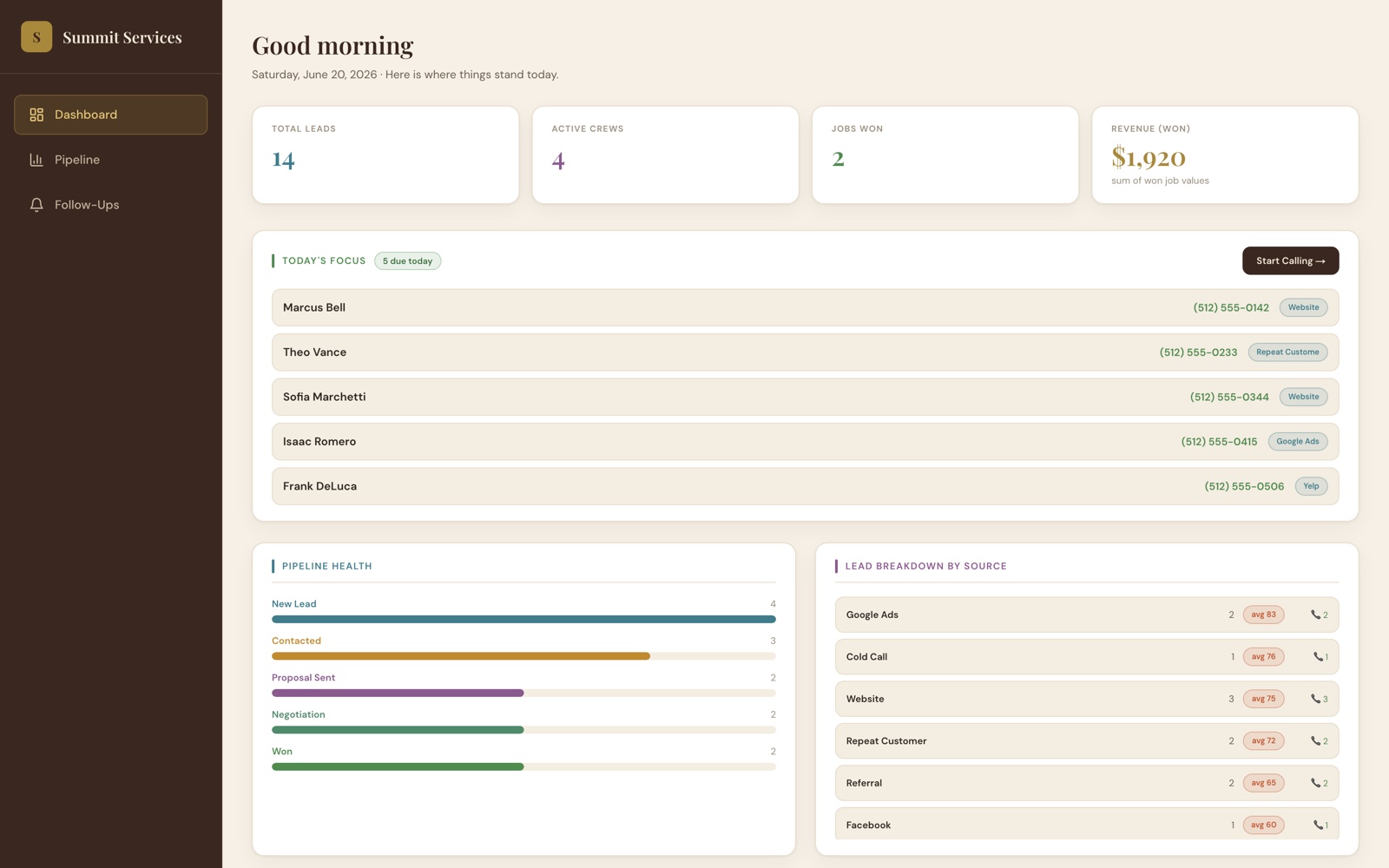
Something built this way, running


A real back-office system on sample data. Open it and click through the whole thing.

Screenshot of the Lead & Job Pipeline CRM dashboard

Lead & Job Pipeline

A service company’s whole operation in one place: dashboard, job stages, quotes, scheduling, follow-up reminders, call logs, and a customer view. This is what “custom” actually looks like when it’s finished.

Custom Software · Interactive Demo

Open the demo →

There’s also a live one. Golden Rose Advisors buys homes for cash, and behind their public site is a private back-office system their team runs every deal through. You can see the front of it on the work page.

What it costs


Custom tools and business systems start at $2,500 and are scoped individually, because these projects are genuinely different sizes. A single dashboard that finally answers the Monday questions is one thing. A portal your customers log into is another. Everything, including the website packages underneath it, is on the pricing page.

You own it when it’s done. The code, the accounts, the data. There’s no per-seat fee for hiring somebody, and no monthly bill that grows because you had a good year.

Not sure yet

Tell me the question you can never answer quickly, and I’ll build you a free mockup of the screen that would answer it. Real, clickable, no cost and no commitment. If it feels right, we keep going. If it doesn’t, you’ve still got something to look at.

Questions people ask first


How long does something like this take?

A first working version is usually a few weeks, not a few months, because I build the one part that hurts most and put it in your hands before building anything else. You’ll be using something real long before the whole thing is finished.

What happens if you get hit by a bus?

Fair question, and you should ask it of anybody who builds you something.

You own the code, the accounts, and the data, and it’s all written in ordinary tools another developer can pick up. Nothing is locked to me, and nothing stops working if you stop working with me.

Am I too small for this?

Size isn’t really what decides it. What decides it is whether the way you work is unusual enough that ordinary software keeps getting it wrong.

A three-person shop with a genuinely odd process is a better fit than a fifty-person company doing something completely standard.

Can it work with the software I already have?

Usually, yes. If your accounting or scheduling program is doing its job, it stays. What I build fills the gap around it instead of replacing things that already work.

Related


If it’s really just the leads, and everything else is fine, the smaller and cheaper starting point is replacing the lead spreadsheet.

If the systems mostly work and the pain is entering the same thing twice, that’s a narrower fix.

The narrowest piece of all is catching the calls nobody got to, and it’s worth doing on its own even if you never build anything else.

And if you need a public site in front of all this, that’s the website side.

If you’re in the Buffalo area and searching specifically for local custom software developers, the Buffalo custom software page covers the same work with more context about what that looks like around here.

Tell me what doesn’t fit


You don’t need to know what to call it or how it should be built. Tell me what your business does that the software you’ve tried couldn’t handle, and we’ll start there.

Or call 716-866-8787